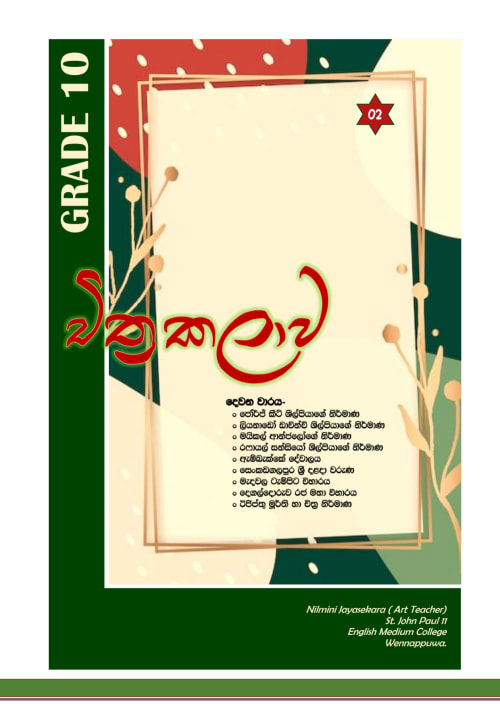
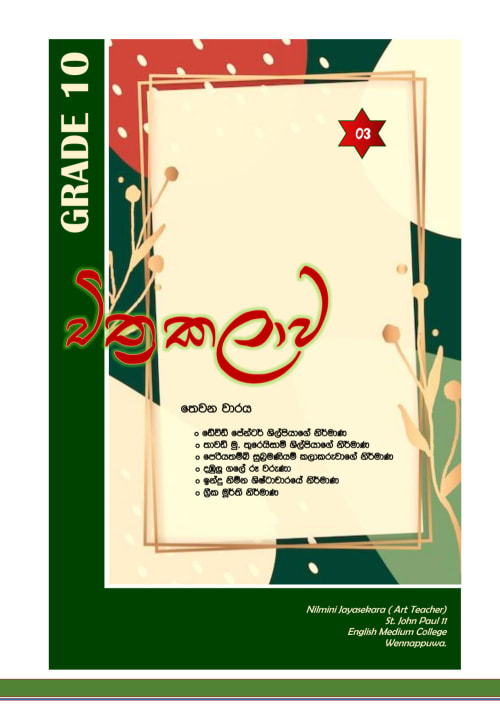
Grade 10 Art Reading Book - Term 1
Grade 10 · ART
Term one of Nilmini Jayasekara's Grade 10 Art reading book. Four units: appreciating the paintings of M. Sarlis, appreciating the paintings of Solias Mendis, the Gadaladeniya Vihara, and the Lankatilaka Vihara. Written as lessons with short exercises so students can work through each topic and check their own understanding.
Community rating
Rate this resource
About this resource
"Grade 10 Art Reading Book - Term 1" is a textbook for Grade 10 Art, prepared by Nilmini Jayasekara. It covers term 1.
You can read 5 pages here before downloading. The full document needs no account and no signup.
Read it alongside the annual teaching plan for the same term - the plan lists the competencies each unit is assessed against, and this book is the material those competencies are taught from. Grade 10 students should work through the terms in order, because later units assume the vocabulary introduced earlier.
What this term covers
Term one opens the Grade 10 appreciation strand with two Sri Lankan painters and two Kandyan-period sites. It is a deliberately small list - four units across a whole term - because this is where students learn how to look at a work and describe it, rather than how to memorise a caption.
- Appreciating the paintings of M. Sarlis
- Appreciating the paintings of Solias Mendis
- The Gadaladeniya Vihara
- The Lankatilaka Vihara
How to work through it
Take the two painters first and the two sites second, because the sites are easier once you have practised describing a picture. For each painter, write down one named work, the period they belong to, and two features you could describe in a sentence each - brushwork, colour range, how figures are arranged. That is the shape an appreciation answer takes.
For Gadaladeniya and Lankatilaka, the questions are usually about architecture rather than painting: the materials, the plan of the building, and what makes the two different from each other despite being built within a few years and a few kilometres of one another. Note that difference explicitly while you study - it is the comparison examiners reach for.
What the exam asks from this term
Nothing here is tested as a list of names. You will be asked to describe a work or a site and say what makes it what it is. Practise by covering the book and writing four sentences about one unit from memory: what it is, when it belongs to, two specific features, and one technique that produced them.