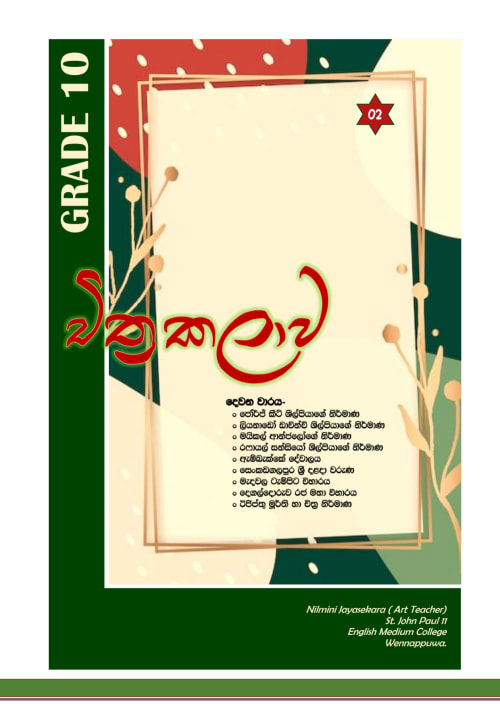
Grade 10 Art Reading Book - Term 3
Grade 10 · ART
Term three of the Grade 10 Art reading book. Six units: the work of David Painter, of Thavil M. Thuraisamy and of Periyathambi Subramaniam, then the rock figures at Dambulla, the art of the Indus Valley civilisation, and Greek sculpture.
Community rating
Rate this resource
About this resource
"Grade 10 Art Reading Book - Term 3" is a textbook for Grade 10 Art, prepared by Nilmini Jayasekara. It covers term 3.
You can read 5 pages here before downloading. The full document needs no account and no signup.
Read it alongside the annual teaching plan for the same term - the plan lists the competencies each unit is assessed against, and this book is the material those competencies are taught from. Grade 10 students should work through the terms in order, because later units assume the vocabulary introduced earlier.
What this term covers
Term three closes Grade 10 by widening out from Sri Lanka to two of the oldest art traditions in the world. Six units, and the balance shifts from individual painters to whole civilisations.
- The work of David Painter
- The work of Thavil M. Thuraisamy
- The work of Periyathambi Subramaniam
- The rock figures at Dambulla
- The art of the Indus Valley civilisation
- Greek sculpture
How to work through it
The three artists are Sri Lankan and comparatively recent, so treat them the way you treated Sarlis and Mendis in term one: one named work, the period, two describable features. They are less written about than Keyt, which means your own description carries more weight in an answer.
Dambulla is the bridge unit. It is Sri Lankan, it is a site rather than an artist, and it sets up the two ancient traditions that follow. Learn the cave layout and what makes the painting there different from the Kandyan murals you saw in term two.
For the Indus Valley and Greek sculpture, do not try to cover everything. Two or three characteristic works each, with what the material and technique were, is exactly the depth this level asks for.
What the exam asks from this term
Questions on the ancient traditions almost always test whether you can name a characteristic feature and say why it is characteristic - not whether you can recite dates. Have one specific object in mind for each civilisation and describe that, rather than generalising about a whole culture.